6 Tips for Effective Water Management Onboard
Boating is an enjoyable activity, but it shouldn’t be taken lightly. The aquatic environment can quickly turn hostile. To fully enjoy your trip or cruise, some planning is required. Let’s talk about fresh water, which is vital for human life.
Proper water management on board is obviously necessary to keep the crew hydrated. But it’s also essential for cooking, hygiene, and maintenance. So let’s go over some guidelines and tips for effectively managing water on board and avoiding supply issues.
Estimating Water Needs
It all starts with accurately estimating your water needs. The amount of water required depends on multiple factors, such as the duration of your trip, the number of people on board, the outside temperature, and so on.
As a rule of thumb, plan on an absolute minimum of 3 liters (or nearly 1 gallon) per person per day. For greater comfort, plan on an average of 10 liters (about 2.5 gallons) of water per person per day if your boat’s capacity allows it. And keep in mind, this average doesn’t include showering! When you consider that a water flow rate of 6 liters (nearly 2 gallons) per minute is considered responsible, it’s easy to see why…
Just as a seasoned sailor factors in a pilot’s margin when navigating, they also factor in a safety margin for their supplies. That’s especially true when it comes to water, which is so crucial.

Segregating and Managing Your Supplies
Having multiple tanks instead of just one allows you to segregate your supplies. That way, if one of the tanks becomes contaminated, the others won’t necessarily be affected. If you don’t have multiple fixed tanks, you may be able to fit a flexible tank (or “water bladder”) as a supplement. Finally, you can increase your supplies even further with jerry cans or bottles of mineral water. An emergency jerry can filled to 80% capacity (so that it floats!) should remain easily accessible, to be loaded onto the life raft in case of an evacuation.
Be sure to top up your supplies whenever possible. A watermaker failure or a shortage of drinking water at port stops can also occur. This is what happened to the crew of Fleur de Sel before their Atlantic crossing from Cape Verde.
Monitoring Water Quantity and Quality
You’ve planned ahead for your water needs and stocked up on water—great! Now it’s important to monitor your levels regularly. For example, install a tank gauge, either electronic or visual, or a water meter to track your daily water usage. This will help you manage your supplies more effectively and adjust your consumption accordingly.
Don’t forget to check the condition of your water reserves regularly. If you have the means to perform sophisticated tests, all the better. But simply checking the smell and taste will already be very helpful. When refilling, consider using specific additives to prevent the growth of algae and bacteria.
Finally, since memory is never foolproof, a reminder in your Ready4Sea app will help you remember when to replace your filters and when cleaning your tank is overdue. It would be a shame to have to cut your next trip short because of a contaminated tank!
Conserving water
When you’re at sea, water is a precious resource. Simple steps can help you conserve fresh water on board.
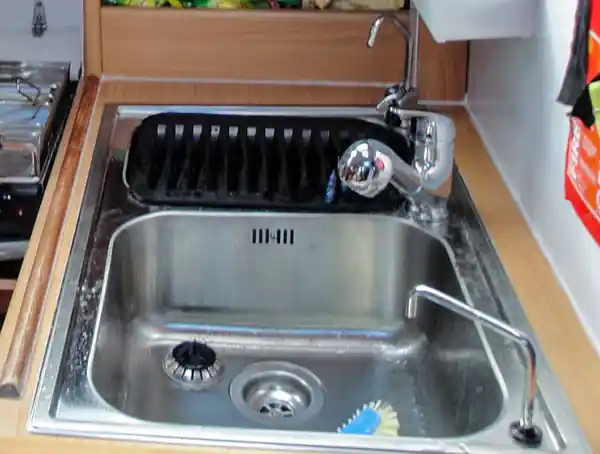
seawater, fresh water, and drinking water!
When you’re not in port, you can use seawater for some chores such as washing dishes or cleaning the deck. And here’s a little cooking tip: when boiling pasta, potatoes, or vegetables, you can replace one-quarter to one-third of the fresh water with seawater. When cooking rice, lessen the proportion of seawater, as the salt will be absorbed more readily.
A foot pump helps prevent water waste. But if you have a pressurized water system, obviously you should never let the water run unnecessarily! For example, you can reasonably use just one glass of water to brush and rinse your teeth. Finally, you can wash yourself efficiently using a 1.5-liter (50 fl oz) water bottle with three holes punched in the cap.
Consider desalinating or collecting water
If you’re planning a long passage with limited access to fresh water, you can collect water from around you. A reverse osmosis watermaker, for example, allows you to produce drinking water from seawater.
There are various types of desalination systems. Those most commonly used aboard recreational crafts operate on the principle of reverse osmosis. They pressurize seawater to force it through a membrane filter. This process extracts a small amount of fresh water and discharges a large volume of even saltier water, known as brine.
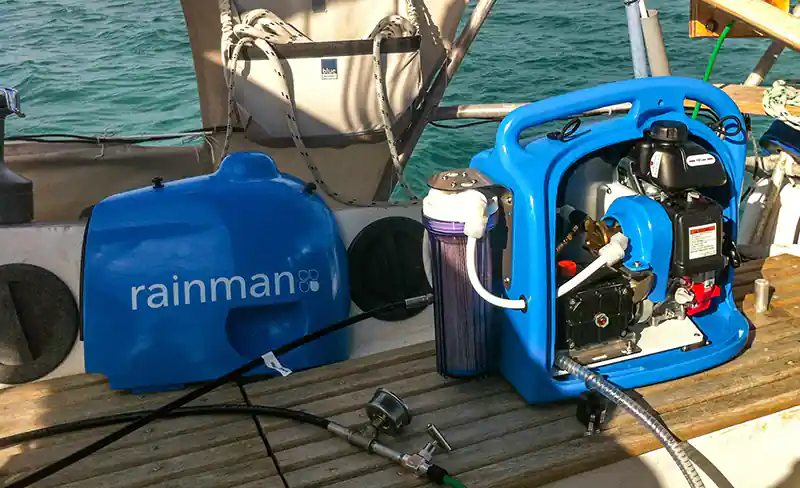
The downside of a watermaker is that it takes up space and consumes a lot of energy: the water must be pressurized to about 60 bar (nearly 900 PSI), which requires both a low-pressure pump and a high-pressure pump. It is therefore not surprising that the entire system requires careful maintenance. Ready4Sea will always be there to remind you of necessary maintenance schedules, but it is best to thoroughly assess the feasibility of the project before proceeding with the installation of a reverse osmosis system.
There is also another way to fill your boat’s tanks when you are far from a tap: rain! You can use one or more tarps to collect rainwater and channel it into a jerry can or your tank using a hose. Of course, this is a system to be used only while at anchor, but it can be very effective: during a heavy rain shower, it’s possible to collect hundreds of liters (tens of gallons).
Storing or Treating Wastewater
Wastewater management is another major concern on board. People often overlook the impact that discharging waste into the sea can have just because we think it’s “natural.” In too high a concentration, our feces can have a dramatic impact on the marine environment.
The solution is to use a holding tank. This temporary storage solution allows human waste to be kept on board until it can be safely disposed of ashore or discharged well offshore. Make sure your heads’ pumping system is working properly and that the odor filters are in good condition. When you add a holding tank, Ready4Sea will suggest creating a yearly reminder for you to replace the filter. Handy!
Subscribe to our monthly newsletter to receive tips on keeping your boat in good health.
Other environmentally friendly solutions exist to enable the discharge of wastewater, such as UV treatment. This is a disinfection method that uses ultraviolet light to neutralize bacteria and viruses present in feces. However, it is often used in conjunction with other treatment methods, such as filtration, to ensure complete disinfection of the wastewater.
Another environmentally friendly solution is the neutralization of blackwater through electrolysis. This method uses an electrochemical process to eliminate bacteria and viruses in the water. Electrodes are placed in the water, and an electrical charge is applied to generate a disinfectant. This disinfectant is then released into the wastewater to neutralize bacteria and viruses.
You can also use a gray water collection system to collect wash and rinse water from showers and sinks. This gray water can then be used to clean the deck or for other nondrinking purposes. Before cleaning your boat, however, be sure to check the regulations in effect in your area. In many places, the direct discharge of gray water is prohibited and may result in fines.
Wrapping up
Water on board is critical to the success of any boat trip. This requires effective management. Each of the systems involved requires regular and thorough maintenance to ensure they function properly and safely.
By estimating your water needs, building adequate reserves, conserving water, monitoring water levels, using a watermaker if necessary, and properly managing wastewater, you can avoid water supply issues and protect the marine environment.